
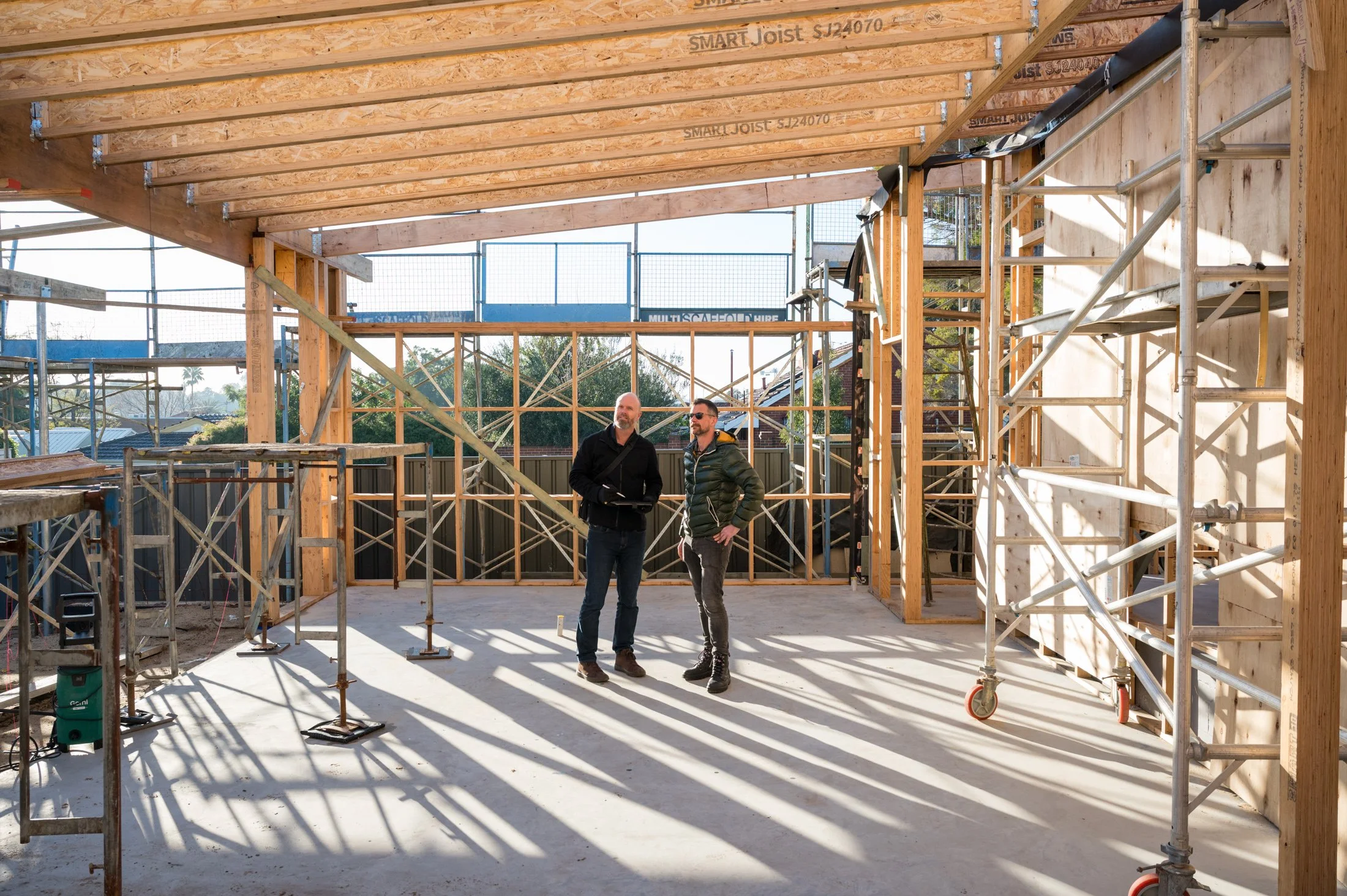
Brick and skills shortages are pushing up costs and blowing out timelines for Perth's once-reliable building method. It's time to ask whether double brick still makes sense.
Perth has a long and stubborn love affair with double brick. Drive through almost any suburb built in the last fifty years and the evidence is everywhere: two leaves of brick, inside and out, wall after wall. It's what worked when there was an abundance of local clay and skilled immigrant labour, and what Perth homeowners have been told to trust.
But that reliability is quietly unravelling and the numbers behind it are not pretty.
The industry reality, right now
Perth's construction sector has been under serious strain for several years, and the pressure shows no sign of lifting. Build times for residential properties have risen approximately 80 percent over the last several years, while construction costs have surged around 40 percent in just five years. That's not a temporary blip. That's a structural shift in what it costs and how long it takes to build a home in this city.
For double brick construction in particular, the pain is concentrated in one trade above almost all others: bricklayers.
Bricklaying has become the most severely affected trade in WA, with bricklayers now charging between $4.28 and $5.35 per brick — a dramatic increase from around $2 five years ago. Think about that for a moment. A standard Perth double brick home uses somewhere between 15,000 and 25,000 bricks. The maths are not kind.
Why is the bricklayer shortage so acute? Perth's reliance on double brick is a significant part of the problem. A double brick home requires a bricklaying team to spend several weeks on site, compared to just a couple of days to erect timber wall frames. Perth's construction model simply uses more bricklayers, for longer, on every single job.
And those bricklayers are increasingly hard to find. Perth faces the worst trades shortage among Australian capital cities, with record-breaking mining employment drawing workers away from residential construction. Mining now employs over 135,000 on-site full-time positions in WA alone, and the wage differential makes it difficult for residential building to compete.
Apprenticeship completions dropped 15% in 2023, and new starts fell 22% compared to 2022. The pipeline of new bricklayers entering the industry is shrinking at precisely the moment demand for them is highest.
The result: longer waits, higher prices, and a construction method that is increasingly difficult to deliver reliably.
Double brick was never ideal for performance anyway
The shortage and cost crisis is exposing a truth that high-performance builders have been raising for years: double brick was never the optimal choice for a comfortable, energy-efficient home. It just happened to be the default.
Here's the problem. Double brick is a dense, thermally massive material. It absorbs heat during the day and radiates it back at night. In Perth's climate, where summer days are long, hot and relentless that means a double brick home that heats up during the day continues releasing that stored heat into the evening, well after you'd like it to stop. The house becomes a slow-release radiator.
Achieving meaningful thermal performance in a double brick home requires significant additional insulation. But the geometry of double brick construction limits where insulation can practically go and how thick it can be. The wall system that defines Perth's housing stock is one of the hardest to retrofit to modern comfort and efficiency standards.
Airtightness, a cornerstone of Passive House construction and genuinely comfortable homes is similarly compromised. Brick is a porous, jointed material. Achieving the continuous air barrier required for a high-performance home demands significant additional effort, detailing and cost on top of an already expensive structure.
Timber framing, by contrast, is a system designed around the wall cavity. Insulation fills the frame from the start. The structure itself facilitates the performance outcome, rather than working against it. We covered the case for timber in detail in our earlier post on five reasons to choose timber framing and the argument has only strengthened since.
The skills challenge and how it's being solved
The honest reality is that Perth has always had a timber framing skills gap. The city built itself in brick, and its tradespeople trained accordingly. For years, one of the genuine barriers to shifting Perth's building culture was simply finding builders who knew how to frame in timber to the standard required for a high-performance home.
At Leanhaus, this has been one of the central challenges we've worked through over more than a decade of practice. Our answer has been to build long-term relationships with builders who bring the right skills, often those with experience in European or eastern-seaboard construction, where timber framing and Passive House detailing are the norm rather than the exception. It has taken time and real effort. But it is working.
Importantly, the industry is beginning to shift. Prefabricated timber framing is increasingly available in WA, offering factory precision, reduced site waste and faster assembly. The skills are developing. The supply chains are improving. And as more clients demand high-performance outcomes, more builders are developing the expertise to deliver them.
What this means if you're planning to build
If you are planning a new home in Perth and you haven't questioned the assumption that it will be built in double brick, now is the moment to do so.
The cost premium for double brick over timber has narrowed dramatically, and for many projects, it has reversed entirely. When bricklayers are scarce, your project waits. When bricklayers are expensive, your budget blows out. When the construction method itself is a bottleneck, your timeline is hostage to a single trade.
Timber framing sidesteps that dependency. It is faster to erect, more compatible with prefabrication, and critically far better suited to the insulation and airtightness detailing required for a genuinely high-performance home.
Double brick had a long run. Perth's devotion to it was understandable for decades. But the conditions that made it the default choice are eroding; in cost, in timeline, and in the rising expectations of what a well-designed Perth home should actually feel like to live in.
The days are numbered. And for the homes we want to be building, that's not a problem. It's an opportunity.
Leanhaus is a Perth-based design and build practice specialising in Passive House and high-performance residential architecture. Get in touch to discuss your project.